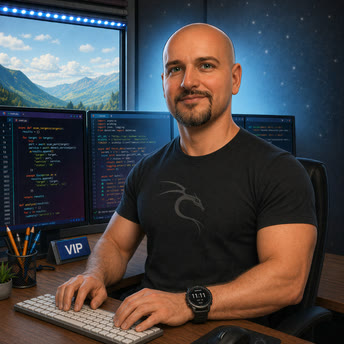
Rumen Damyanov
Work
I build web applications, distributed backends, and low-level Linux services.
To me, technology stacks are just tools chosen to fit specific constraints. There is no single "correct" language or paradigm. The right choice always depends on system design, runtime constraints, memory safety, and performance. Whether I'm building high-throughput APIs or lightweight system utilities, I pick the best tool for the job rather than fitting the problem to a fixed stack.
My recent work is bridging robust backend systems with modern AI orchestration: intelligent workflows, stateful agentic pipelines, and reliable automation. On the security side, my focus is strictly defensive: designing secure system boundaries, hardening application architectures, and building for resilience in production. Whenever possible, I release general-purpose tools and utilities as open source.
Before that
Software came later. The subject that stuck in school was physics, and for a while I was sure I'd end up in astronomy.
I was very young, still barely able to read, at the age when a serious book simply tells the truth. I got hold of an astronomy textbook meant for high school students, years ahead of me. There was a picture of Yoda in it. I took him for a real alien, and decided that would be my job.
After elementary school the formal track was banking: I trained as an economist for the banking sector. A job in a bank was where that road was supposed to end. It was never going to be me.
By then I was already teaching myself to program. First I wanted to know what actually made games move. Later, still in high school, I trained with the national team coach for contests meant for older students. I finished top of that group, and he said there would be a place on the team once I moved on. Life took another road, and I missed it.
English I had to pick up on my own. School never gave me a real start with it. German was the language I was taught in class, and it never really stuck. I learned English by using it, without a teacher, until I understood it at a level you can certify as C2.
School also showed me what money can buy. In middle school I had the top score for the A class and still didn't get in, because my parents couldn't pay. Later, the lessons that mattered sat behind private tutors and private academies, and I couldn't afford those either. I got into a university program with the top score. At the head of that place I didn't find the odd bribe. I found a moral collapse. Since then I don't think much of people whose only proof is a diploma, and who never actually worked in the field they paid to be certified in.
The rest
Films pull me in two directions, and I don't have to choose. One is hard science fiction that stays with you for days: time loops, closed circles, the kind of plot you end up sketching on paper. Primer and Arrival are exactly that feeling. The other is stylized crime and dark comedy, sharp dialogue and a proper laugh. Pulp Fiction, Snatch, the joy of how a scene is cut. If a film gets either one right, I'm in.
My music is a happy mess. I want a strong rhythm and real atmosphere, and the genre barely matters. Dark rock, heavy grooves, clean European electronic music and trance from the nineties on. What gets me is the production and the voice, the sense that someone built the track with intent.
Games started with shooters and strategy on old PCs, and slowly turned into puzzles. These days I want a world I have to figure out: atmospheric, a little strange, a problem you can walk around inside. Portal, The Talos Principle, that kind of game.
All of this does something good for me. A story, a song, a puzzle gives the mind somewhere to go that isn't work, and I come back clearer. Imagination and making things aren't a hobby I fit into a calendar. They're a big part of how I stay well.
Next
I want more of the work that already feels like mine. Deeper into systems on Linux, where a small tool can do something real. Open source when there's a reason to share it. And enough freedom to choose the problem, not just take whatever lands on my desk.
I want the other half to stay alive too. The films, the music, the puzzles, the long detours of the mind. That's not a reward for later. When that side goes quiet, the work gets thinner too.
If job titles didn't matter, I'd still be leaning over something big, trying to see how it's put together. A rocket. A shot. A piece of music. I don't need a new title for that. I need room to keep following it.
There are places I want to actually be in, not tick off a list. Japan, for its culture, not its souvenir shops. I want to get lost in translation there, and if a girl in a pink wig crosses the street, I'll know which film I've walked into. Next to it, China: the Great Wall, the Shaolin temple, stone that still carries its history.
Then the Americas, country by country. Mexico, Colombia, Peru, Bolivia, Chile, Ecuador. The old Maya, Aztec, and Inca cities, and everything still standing between them. The far north of Norway, above the Arctic Circle, for the fjords and the northern lights. Australia and New Zealand, and the Great Barrier Reef, which I want to see with my own eyes. Old walls, temples, the way a people chose to build. That history feels as alive to me as any system I work on.
Taking my work with me sounds more tempting every year. A laptop, a place I picked, and the same curiosity. I don't want a quick tour of the world. I want to stay in a few of these places long enough to feel how they were made.